Straight answerNew Zealand has five introduced social wasps: two Vespula species (German and common wasps) and three paper wasps. They are the ones that build nests and sting in numbers. The country has no native social wasps. Native wasps such as mason wasps and hunting wasps live alone and have never become a nuisance, so they don't need removing.
Quick ID: which wasp is it?
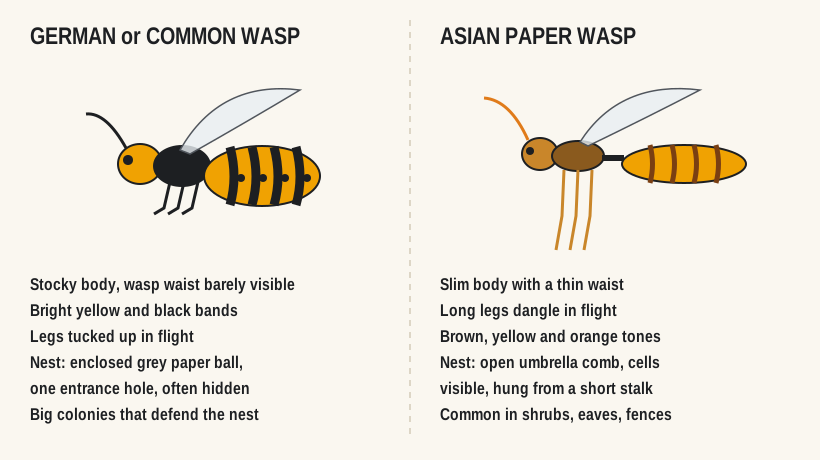
Start with how it flies and where it lives. Stocky, bright black and yellow, legs tucked up: German or common wasp. Slim, long legs dangling, brownish with yellow rings: paper wasp. All black and working mud into a crack or keyhole: native mason wasp. Very big, mostly dark with yellow legs: possible hornet, report it.
| Wasp | Looks like | Nest | Action |
|---|---|---|---|
| German or common wasp | Stocky, black and yellow, legs tucked | Covered paper ball, often hidden | Treat if near people |
| Paper wasp | Slim, brownish with yellow rings, legs dangling | Open umbrella comb on a stalk | Treat if near people |
| Mason wasp (native) | All black | Small mud cells in cracks and folds | Leave alone |
| Spider-hunting wasp (native and introduced) | Sleek, black, smoky wings | None you will see; solitary | Leave alone |
| Ichneumon wasp | Slender, often orange | None; parasitic | Leave alone |
| Yellow-legged hornet | 2 to 3 cm, dark, yellow legs and face | Large round nest, often high up | Report to MPI |
The wasps that cause problems
German wasps and common wasps are behind most stings and nearly all big nests. Paper wasps cause trouble mainly when their combs are beside doors, paths and hedges people trim. All five introduced social wasps are roughly 11 to 16 millimetres long, and all of them can sting more than once.
Native wasps you can leave alone
New Zealand's native wasps are solitary hunters. The mason wasp is fully black and builds small mud cells in curtain folds, keyholes and cracks, each stocked with a paralysed spider. The large black hunting wasp chases big spiders. Orange ichneumon wasps lay eggs in caterpillars. None of them form colonies, and DOC notes native wasps have never become a nuisance.
Hornets: report, don't remove
Hornets are not established in New Zealand, but yellow-legged hornets were found on Auckland's North Shore in October 2025 and are under eradication. They are much bigger than our wasps, at 2 to 3 centimetres, with a dark body, yellow face and yellow-tipped legs. Don't approach one. Photograph it if it is safe and call MPI on 0800 80 99 66. Full hornet guide.
Wasp or bee?
Bees are hairy, collect pollen and build wax nests. Wasps are smooth, chew wood into paper nests, and can sting more than once. Honey bee swarms and bumblebee nests are not pest jobs: beekeepers collect swarms, usually for free. Bees vs wasps, side by side.
Questions people ask
How many types of wasps are in New Zealand?
Many, but only five cause trouble. Landcare Research lists five introduced social wasps: the German wasp, the common wasp and three paper wasps. The rest are native or introduced solitary and parasitic wasps that don't form colonies and rarely sting people.
What is the black wasp in New Zealand?
Usually a native one. The mason wasp is fully black and builds mud cells in cracks and folds. The large black hunting wasp is sleek and black with smoky wings and hunts big spiders. Both are solitary hunters, DOC says native wasps have never become a nuisance, and neither needs removing.
What is the orange wasp in New Zealand?
Often an orange ichneumon wasp, a slender parasitic wasp about 20 millimetres long that lays its eggs in caterpillars. It doesn't build a nest or live in a colony. A reddish-brown wasp with yellow rings and dangling legs is more likely an Asian paper wasp.
Are there hornets in New Zealand?
Hornets are not established. Yellow-legged hornets were detected on Auckland's North Shore in October 2025 and MPI has been running an eradication. DOC reported no new finds since early April 2026, but monitoring continues. Report any suspected hornet to MPI's biosecurity hotline, 0800 80 99 66.
Sources we checked
- Vespula wasps (Manaaki Whenua Landcare Research)
- Wasp identification (Manaaki Whenua Landcare Research)
- Mason wasp (Manaaki Whenua Landcare Research)
- Spider-hunting wasps (Manaaki Whenua Landcare Research)
- Orange ichneumonid wasp (Manaaki Whenua Landcare Research)
- Wasps (Department of Conservation)
- Yellow-legged hornet (Department of Conservation)
- Yellow-legged hornet flyer (Oct 2025) (Ministry for Primary Industries)
Last reviewed 2026-10-06.